Thursday, 29 May 2008

Eastern Peripherique walk


Dear Rachel,

My walk started at the Parc Bercy, which is on the north bank of the Siene in the 12ar, it is elegantly landscaped with various institutions contained in the park like the Palais Omnisports de Paris-Berc with grass growing on the sloppy sides. and the Cinématèque Français. On the other side of the Siene is the Bibliotheque Francois Mitterrand, with 4 towers cornering a sunken garden like book ends. Connecting the two is the footbridge Simone de Beauvoir.

The park feels like the last place going east along the Siene where a pedestrian is meant to be. The road next to the river soon became the dual carriage way which leads to the Périphérique. As the road became more inhospitable there were barriers and wire fences to separate the drag along the river from the dual carriageway. Lining the edge of the river itself were a series of industrial estates, cement works and builders wholesalers, so I was sandwiched in only able to go on or back. I saw a long boat carrying sand pass down the river. I imagine that this area would have been a good place for industry historically using river for transportation of building materials and goods.

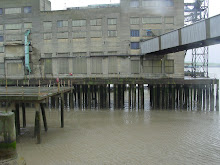
I was now walking on a small tarmacked path with sides like motorway barriers on either side. The white markings divide it into cycle lane and pedestrian. To my left the dual carriage way and to my right the river. It seems to be on stilts over the river at some points. There are signs telling me the pedestrian path is ending, but no way of getting out where I have got to but going forwards! I am a little hesitant as i am with B asleep in the pushchair, but carry on using the cycle lane. We cross under the Périphérique bridge which is a utilitarian concrete structure. Then suddenly there are signs telling me that the pedestrian path begins again. Not sure how the pedestrian was meant to get from where the last was to here, perhaps swimming or walking on the dual carriage way.

Just after the bridge I came across a fenced off area by the river with various things stored, eclectic pieces of building materials. Then there are a small number of shanty dwellings, made from plywood, tarpaulin, rope. Some are together like terraced houses, a few stand alone. They have quite robust doors with locks on. I saw a kitchen window with venetian blinds. A man opened a door, and started walking along the path towards Paris. He looked quite ordinary in a black shirt and jeans.

Then I came across what looked like an ornamental section of an 18/19th century bridge, standing alone on the grass by the river. I wonder why it was left there? perhaps the whole bridge was destroyed to make way for something else. Then a tent, another temporary home for someone.

Next I pass under the ponts Nelson Mandela which from the map seem to be part of a contra flow traffic system. I catch sight of some caravans under the slip road which leads onto the second bridge. As I get closer I can see it is a gypsy encampment. There some men sitting outside watching the river. In the space just where the bridge meets the ground I glimpse a constructed interior, there are hundreds of teddy bears and soft toys attached to posts with string. It looks fascinating, but I doubt the interest would be welcome, so I try to see as much as possible as I walk past, while attempting to look disinterested!

All this is happening just by the dual carriage way. I pass another place selling industrial materials.

Then I caught sight of the point where the Seine meets the Marne. As a key geographical point, I had anticipated something in the surroundings to mark it. But was greeted by a huge corporate Japanese pagoda type building. Bizarre and kitch. I pass by a sports ground and lots of noisy school children. B wakes up. There is some building work going on here so to reach the foot bridge crossing the Marne to the land in between I snake through temporary corrugated fences. The Marne feels like a big contrast to the Seine - much smaller and has a bucolic feel to it. I spot a submerged rubbish collecting boat in the water with a large teddy bear floating on top.

Over the bridge I am in Alfortville. I photograph some net curtains with a windmill motive. It makes me think of Emily Wolfe's paintings, an idealised piece of the countryside appropriated and contained. Alfortville has the feel of a place with its own history separate from Paris, but a bit down at heal. There is some graffiti "Alfortville 94" - the postal area, I wonder if the local people / gangs have a pride in there non-Parisian identity like in Saint Denis.

With B awake we jump on a bus headed for the Bois de Vincennes, just over the Marne back near the 12ar.

Thursday, 17 April 2008

Hi Rachel,
We didn't buy the catalogue as we have a huge book with much of the same material in it, languishing in our garage in Forest Hill! but I will go back with my camera. I feel we are getting to the stage where we could start to make plans for other pieces of work. Not necessarily to begin them yet, but to enable our research to be more focused.
S

re Team 10

Hi Suzy,
The Team 10 exhibition sounds interesting - especially as you could see the dialogue that took place between European architects.
I like the way you describe the displays, and the idea that we might use similar approaches in the way we display our work. Did you take pics of the exhibition? It would be so useful to see. There is an element of deconstruction and re-invention in the way we work and a multi-faceted and organic means of displaying material makes sense with that. I think there was an element of this in 'New for Old' but it would be exciting to push this much further.
The way medieval architecture informs a new build in Giancarlo de Carle's referencing of the medieval city of Urbino in his designs for 'Collegio dell Colle' is very interesting. Perhaps we could find out more about this? Again, this relates to our on-going interest in the medieval city.
I really like the idea of pushing the use of flexibility in our work and encouraging more interactivity. Again, 'Sprawl/what gets carried by the river...' had this potential, and I think some parts were re-arranged by children (!), but we could make this an integral part of the work.
Was there a catalogue for the show? Perhaps I can get hold of a copy.
Rachel

Friday, 11 April 2008

Team 10 show


Dear Rachel,

We have just been to a show at the Cité de I'architecture http://www.citechaillot.fr/index.php in the 16ar. It's about Team 10 http://www.team10online.org

Its interesting for us because these people were at the forefront of ideas in European architecture from the 50's to the 80's. Behind a lot of the ideas that we admire. They saw themselves as having moved on from Le Corbusier rather than advocating a self referential modernism, considering historical context, local issues much more.

The exhibition had a huge mixture of archive material - original drawings, videos of the sites when they were being constructed similar to our archive photos of Thamesmead. I liked the way the show was displayed, it felt visually rich and inventive as spacial, social, political and aesthetic issues were explored through imagery, using collage, photo montage. Mostly displays of team 10's original work.

These were exploratory works made before building. But it made me think about the contrast and similarities to our work that we make responding to architecture from this period maybe 40 years on. There might be clues in the language that they use that could inform our work.

2 ideas stood out for me from the show. One was from a building by Giancarlo de Carle 'Collegio dell Colle' part of the University of Urbino 1962-66. from the exhibition blurb......'The building is conceived as a small city, a sophisticated complex of relationships between spaces and their inhabitants and their experience of the environment. De Carlo drew inspiration for this organization from the structure of medieval Urbino....there is an obvious analogy between the system of pathways, stairs and terraces at the Collegio dell Colle and the intricate network of street and squares in the historic city of Urbino'

See http://www.studioargento.com/GDC/ for quicktime look around the building

The other was flexible structures. Team 10..... 'developed various models for minimal structures within which the city or a building could develop flexibility and provide space for different forms of appropriation by individuals or groups.' One example is from the Freie Universitat in Berlin, the Humanities and Social Science Centre or 'web building' which consisted of a layered composition of flexible floor areas, patios, and streets. The intention was that the building could develop with the layered areas as an open institution in which boundaries between faculties blurred and and spaces are adapted by students and professors.'

It made me think about how our work can be shown differently depending on the gallery space, and especially your constructions for 'Sprawl: what gets carried by the river' and the way that they could be to some extent moved by the viewer. I wonder if we could expand this idea and made work that can be deliberately transformed in several ways by the viewer. I quite like the idea of us as the makers losing some control.

There was also a video of Alison and Peter Smithson taking about social problems on estates and the architect's responsibility, which i would love to find a transcript of.

S

Tuesday, 25 March 2008

Walk to Saint Denis


Dear Rachel,

Matt, Barnaby and I walked to saint denis on friday, starting at Parc de la Villette, which is on the north east edge of Paris, close to la Peripherique. The park was designed in the 80's flatterning an area that used to be the city's main cattle market and abattoir. Reminds me a bit of centre Pompidou. Very dramatic buildings with a sense of humour. There are various museums there - Musee de la Musique, Cite des Enfants and La Cite des Sciences et de I'Industrie. Designed as a dramatic and ambitous space. All landscaped around the canal which divides here - canal de l'ourcq going towards the east and canal st denis running north towards the seine which we took.

The weather was so dramatic we almost gave up before we reached the Peripherique. Really dramatic wind and rain. But we settled for an intense drissle, B went to sleep in the pussette, and we were soon rewarded with some intermitant sunshine and rain.

Looking either side of us as we walked we could see a horizon for the first time in ages and some industrial semi derilict spaces that you don't really encouter in Paris. It reminded me a bit of the canal near my old studio in Hackney Wick. Matt and i both relaxed and felt more cheerful than we had in ages.

We came across a collection of curious carved stone shapes a bit like traffic cones under a bridge. We can't imagine what they are for or why they are there. They seem like figures or an archeological ruin.

From the top of a bridge I took a couple of pictures of the panorama. There were so many different kinds of spaces and buildings. Reminded me of Jeff Wall's 'A Sudden Gust of Wind'.

What happens on the edge of a city? I'm interested in the Peripherique as a boundary. It's just a bland, grid locked motorway. I took a couple of photos of as it goes over the canal. Nothing like the sense of occasion that you would have had with a city wall.

There are lots of traces of derilict industary, Like train tracks on the canal tow path, and more recent detritis like a keyboard under a tree and loads of rubbish in the water.

Some buildings had been knocked down and the site was over grown. I am always fasinated by homes that are half pulled down so you get a sense of the rooms and elements from the interior, thrown up in a space that feels very far from domestic. We passed apartment blocks and houses with some of the windows bricked up and others missing. The semi derelict spaces create a sense of layering, decay and wear revealing what is underneath.

I saw some grafiti which reminded me of the modular form of Thamesmead graffiti, where the TM is combined with names or names of gangs. Here was 'Pop' with the '93' postcode of Saint Denis.

Across the road we saw the Stade de France where England was defeated in the friendly last night. Saint Denis was suddenly there much quicker than we had imagined. I approached the canal to take a last picture with the RER station, when a man from a group of homeless people came up to me shouting. He was very concerned that I wasn't going to take a picture of them. And demonstrated how he would throw my camera 'dans la Seine' if I did. Thinking of ourselves as 'urban tourists' How you view and record other people is a very sensitive subject. I guess people's environment is an extension of that.

We spent some time in saint Denis, we were struck by the lack of white or seemingly middle class people around. When we left the RER station was crowded and there was a sense of agro due to the huge queues for tickets and lack of staff. It is clearly not as well managed as stations in Paris. Chatting to Parisians about our walk, I am constantly met with surprise that we would want to go there from people who have never been.

S

Monday, 18 February 2008


Dear Rachel,

Here is an image from the show at Chats Palace, showing our postcards in the context of all the leaflets and postcards normally on display.

Also I thought you might be interested in some images I took while in Strasbourg. We took the bus accross the boarder to Germany. Its about a 20 min journey to Kehl. The countries are separated by the Rhine at this point. But Strasbourg has been part of Germany historically and the Issenheim Alterpiece which we went to see in Colmar was painted by Grunewald when Colmar was in Germany. (really worth seeing)

Anyway being british its intriguing to see what happens at a boarder when the countries are part of a huge land mass. It was very banal, no sense of occation or anything really to mark it. Derilict police stations on each side. Which must be a good thing. And people taking sunday stroles on either side of the bank.

I think there is a link with our ideas about cities and teritory and where places begin and end or fade out. We have been thinking of it in terms of areas within the urban environment but maps and boarders can be controvertial and political. (Kosovo was created yesterday but not everyone agrees) As i think they are too on a smaller scale in cities (living somewhere implys social status, opportuties or lack of etc), sometimes areas are teritories but with no obvious boundary. I was interested in Isolarion when James Attlee talks about the plans to give Cowley road some demaration and how against it he was.

He quotes from Walter Benjamin p88"Nowhere except perhaps in dreams, can the phenomenon of the boundary be experienced in a more originary way than in cities. To know them means to understand those lines that, running alongside railraod crossings and accross privately owned lots, within the park and accross the riverbank, function as limits...A new precinct begins like a step into the void - as though one had unexpectedly cleared a low flight of steps."

I was also thinking about Iain Sinclair's orbital, walking the m25 a kind of boundary for london and all the banal out of town developments that he finds there.

Sx

Friday, 15 February 2008


These postcards edited to include the suburbs of Oxford comments on the relationship tourists and outsiders have with famous cities like Oxford and Paris – and the way these cities present themselves to visitors.


Hi Suzy,
It was good to catch up with you last night at Besame Mucho. It was such a fun event, with some interesting and quirky performances. I particularly enjoyed Holly Pester’s performance (about “steam coming off men”)!

I’ve uploaded pictures from my walk up the Cowley Road from The Plain to the ring road (see www.flickr.com/photos/barbaresiandround). I just have one more leg of the journey to do – from the ring road to Blackbird Leys. The first part of the walk is an overload of visual information. There are so many eccentric shops and signs, and numerous interesting businesses that reflect the multi-cultural area. The richness and colour of this part of the road make the remaining section from Magdalen Road to Temple Cowley seem very bland. There are fewer pedestrians here and the houses are tatty and faded. Every now and then there is a glimpse of open green space where there are allotments or common land.

I’ve been dipping into a book by Lucy Lippard called ‘The lure of the local’. She makes some astute observations about city dwellers…
“The urban ego is in fact parochial; New Yorkers (like Parisians or Bostonians) are among the most provincial people in the world. They are often as bound to their own neighborhoods and as ignorant of the rest of the city (aside from midtown) as any small towner. A city is a center plus the sum of its neighbourhoods, a collage created by juxtaposing apples and oranges…”.
We’re so unadventurous – but I wonder why this is? And why would I feel quite comfortable walking in some areas of Oxford, whereas in others I feel like a trespasser?

It was great to see the postcards you had made for Besame Mucho – and to see both sets of cards together. I am putting up a couple of pics I took of mine, and will photograph yours as well once they’ve been returned.

Rachel