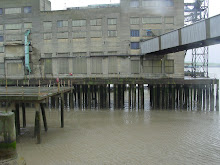
Saturday, 3 April 2010

Brunel University


Hi Rachel,

I've put the photos of Brunel University on www.flickr.com/photos/barbaresiandround and found out a little about the history of the Campus at Uxbridge.

It came about from the radical changes made in further education post-war, whereby each education authority had to submit plans for its own area with a view to meeting the growing needs of the population. Brunel university was a development from Acton Technical college. In 1957 it was decided that the facilities at Acton were holding back the college's growth. One site contintued at Acton with National Certificate and craft courses, and approval was given for the site at Uxbridge to focus on technology and was called Brunel college of Technology, then was granted University status in 1966. In 1971 it left the Acton site and the whole University was brought together at Uxbridge.

The site and buildings were designed by Sheppard, Robson & Partners www.sheppardrobson.com and the main phases built in 1965-7. The idea of the students feeling loyalty to the University as a whole rather than just departments was important to the concept. The buildings are interconnected and are designed to bring students of different discaplines together.

S

Sunday, 28 February 2010

more Landy


Was wondering about Oxford / Paris Correspondence and how we made art from very little, or things considered without value - literally discarded. How does it relate to ideas about giving art value? It probally has little relationship now. It's the opposite of contracts medieval artists had with a church they were being commisioned by, where the amount of lapis lazuli and gold leaf in a madonna would be specified.

I went to the closing party. It was interesting to see the types of work people had thrown in. Lots of big painterly painting. What people decide is a failure is to a large extent about the contemporary situation and that is a collective thing.

Michael Landy Art Bin


Hi Rachel,

I took one of our postcards to the Art bin at the South London Gallery last weekend. Michael Landy was there and asked me about it. It was one of the bourse de travail or job centre designed by Niemeyer in the northern Parisian suburb of Bobigny.

I guess he wants to make sure that people aren't coming and putting their rubbish in it. But I had to fill in quite an official form about rights to the work and it was archived. I was looking at his tweet www.twitter.com/LandysArtBin and he was talking about peoples contributions. He seems to value things sent from a long way or where there is alot of effort or loss involved.

Sx

Wednesday, 21 October 2009

Berlin Wall Paintings


Here are some outdoor paintings/mosaics I found around Berlin.

Schlangenbader Straße


Hi Rachel,

Just taken paracetamol plus caffeine by accident as I was going to bed. Its 1.00 and no sign of sleep, so hello! Anyway might as well make use of this time. There was no security around the Iraqi embassy, you could just walk in, though you had to negotiate the overgrown foliage and trees blocking pathways and exits. The thing that is so bizarre about the place and why it has been abandoned is that no state has authority over it. DDR does not exist, and I guess Iraq has other things on its mind to deal with. Technically the German police would have to have Iraqi permission to enter. Call me a paranoid parent, but it did feel just a bit edgy for a family outing.

I hope you don't mind if I keep blogging about stuff at the moment. I know you are not online and have far more significant events happening, but its handy to record things.

I'd like to show you some images of Schlangenbader Straße - The Snake, on the south-west edge of Berlin. Its a housing development with a motorway running through the core of the buildings. Its quite an interesting angle on our work both on housing and the Périphérique and Oxford Ring road and their effect on the spaces and communities around them. Here is a development designed with the road at the centre. It was conceived and built during the 70's and opened in 1980. The apartments cascade downwards in terraces, similar to some of the flats at Thamesmead. It is clearly well maintained and there is a sense of the residents having a pride in their homes. There was also a very imaginative playground running the length of the estate. It has shops, and a cinema as part of the estate.

Friday, 18 September 2009

Back again!

Hi Suzy,
This blog has been much more round than barbaresi lately. I think your life has been a bit more exciting! Still, I've handed in my coursework and started catching up with the backlog now. I have a long to-do list, but there is light...

The photos of the Iraqi embassy are amazing. How on earth did you get access? Was it a private party? Its very interesting that the furniture, books and other paraphernalia are still there after so many years. Is there a lot of security around the building? Or do you think people are just wary?

Its fascinating to see buildings deteriorating slowly, becoming exposed, weathered, out-of-date. Most buildings which are in use change very frequently and their histories are quickly covered up with new layers of decoration or furnishings. This process seems to get faster and faster. I think my grandparents went through most of their lives with the same set of furniture but now most people respond to new fashions and tastes change within a few years. It is hard to find spaces and buildings that have been left alone. I think, for me, part of the appeal of going to the edge of the city for our project was to be in spaces that have been forgotten and allowed to change in slow and haphazard ways. There was also a sense of discovery in really looking at and absorbing places that are usually overlooked.

Tuesday, 15 September 2009

DDR Iraqi Embassy


Hi Rachel,

Back in London now and catching up with stuff. Would like to tell you about our visit to a party at the old DDR Iraqi Embassy, before I forget. It is derelict but in a surprisingly good state considering it has been abandoned for 20 years. Both administrations were in free fall. DDR from the unification and then Iraq from the 1st gulf war in the early 90's. Due to a one-off agreement between the two socialist states this site in Pankow will be forever Iraqi. Apparently the German police can not enter it without Iraqi permission.

The building looks 60's with clean-line modernism. The grounds are an overgrown forest with trees popping up through the gates. Inside were lots of decaying 60's and 70's furniture, with some hints at more sinister uses like matted thick fibres presumably for soundproofing spilling out of a door, and an old manual typewriter with extensions on the keys that looked like they were for typing in code.

Everywhere were images and books celebrating Saddam Hussein. Matt picked up one with pictures of his family on a seaside holiday. There were piles and plies of books. It looks like it was left in a hurry just as it was with no-one packing up any of the documents. Thinking about our theme while looking at Thamesmead of how 60's and 70's architecture grows old, I guess the reasons for neglect or careful upkeep are crucial part of how they are in the present. This is a pretty dramatic example.